Android 13 Head Unit with DSP: Getting More from Factory Speakers
Short answer: a built-in DSP (digital signal processor) on an Android 13 head unit gives you per-speaker control — equalisation, time alignment and crossovers — that can noticeably clean up factory speakers, tighten the driver's-seat soundstage and undo some of the odd EQ a factory radio bakes in. What it cannot do is turn weak speakers into good ones or rescue a bad install; it manages the potential of the hardware you already have.
If the factory sound is boxy, the vocals are unclear and the stage pulls to one side, but you are not ready to strip the door cards and replace speakers yet, a head unit with a real DSP is the sensible first step. This guide is honest about what it fixes and what it does not, so a spec-minded buyer knows what they are paying for.
What can a DSP head unit realistically do?
- Parametric EQ to cut the resonant peaks and dips a car interior creates, for clearer vocals and a more even balance.
- Time alignment to stop the sound collapsing towards the nearest door, pulling the stage back to centre.
- Crossovers to send the right frequencies to each speaker, which protects them and cleans up the sound.
- What it will not do: make small or worn factory speakers powerful, or fix a poor physical install.
How a DSP improves factory speakers
A car is an acoustically awkward space: you sit off-centre, speakers are at unequal distances, and hard surfaces cause reflections. A DSP tackles that with tools a basic bass-and-treble control cannot. Time alignment delays the nearer speakers by a few milliseconds so sound from all of them reaches your ears together, which stops the whole stage collapsing towards the driver's door. Parametric EQ lets you cut specific problem frequencies rather than boosting everything, so vocals come forward and the boxiness eases. Active crossovers make sure each speaker only plays the range it handles well.
Being honest about the limits
This is where a careful buyer earns their money. A DSP does not add power a small speaker physically cannot produce, and it will not disguise a rattly, badly mounted install. If a factory tweeter is tired, EQ can only do so much. The right way to think about a DSP is that it gets the best out of the speakers you have — often a genuine step up — while leaving the option of new speakers or an amplifier for later. If your worry is that "DSP" is just a label with a couple of presets, the test is simple: try it in your own car.
Sound and navigation at the same time
A head unit is doing two jobs at once, so it needs the memory to keep the sound tuning and the navigation both live. A platform with 4GB RAM and 64GB storage keeps Google Maps drawing and music playing without the stutter that makes a cheap unit feel like a compromise. For the full spec view, see our Android Auto head unit buyer's guide.
Set it up properly
A DSP is only as good as its tuning. Start with a flat EQ, set the time alignment for the driver's seat, use the crossovers to protect small door speakers, then make small EQ cuts rather than large boosts. If you are fitting the unit yourself, our installation guide covers wiring the speakers correctly first, which is what lets the DSP do its job.
The AndroidAuto UK 7-inch head unit as an Android 13 head unit with DSP
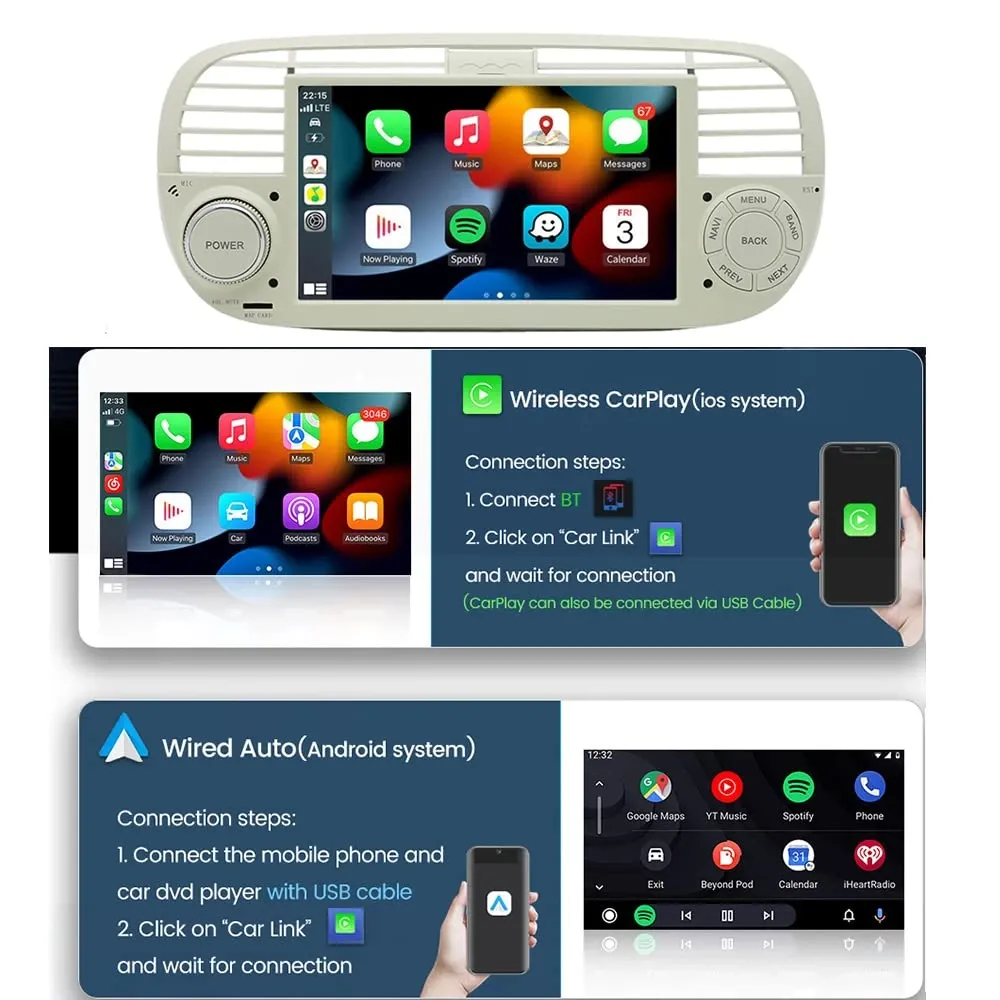
The AndroidAuto UK 7-inch Android 13 head unit includes built-in DSP audio, so you get EQ, time alignment and crossover control to get more from your factory speakers. It is a Double DIN unit with 4GB RAM and 64GB storage to keep sound tuning and navigation live together, wireless CarPlay, wireless and wired Android Auto, an external GPS receiver and a 7-inch IPS screen. It is £236.99 inc. VAT with free UK delivery, 30-day returns and a 12-month UK warranty, and is rated 4.7 out of 5 from 117 reviews. The 30-day returns window lets you test the DSP in your own car; some vehicles need a model-specific fascia or CANBUS interface.
Test the built-in DSP on your own speakers
View the 7-Inch Android 13 Head Unit — £236.99Frequently asked questions
Will a DSP head unit improve my factory speakers?
It can, noticeably. A DSP gives you parametric EQ, time alignment and crossovers, which clean up the resonant peaks and off-centre soundstage a car interior creates. It gets the best out of the speakers you have, but it cannot make small or worn speakers powerful or fix a bad install.
What is the difference between a DSP and a head unit's normal EQ?
A basic EQ adjusts a few fixed frequency bands across the whole system. A DSP works per channel, with finer parametric EQ, plus time alignment and active crossovers that a simple EQ cannot do, which is what lets it correct the acoustic problems of a car cabin.
Can I run navigation and music while the DSP is working?
Yes. The 4GB RAM and 64GB storage platform keeps the sound tuning, navigation and music all live together without the stutter you get on cheaper 2GB units.
How do I know the DSP is worth it and not just a label?
Try it in your own car within the 30-day returns window. Start from a flat EQ, set time alignment for the driver's seat and use the crossovers, then judge the change on your own speakers. That real-world test is more convincing than any spec sheet.
Want cleaner sound without new speakers yet?
7-inch Android 13 · Built-in DSP audio · 4GB RAM · 30-day returns · Free UK delivery
View the 7-Inch Android 13 Head Unit — £236.99